- Young adults lax on passwords, more comfortable with biometric and multifactor authentication
-
People now prioritize security over convenience when logging into apps
IBM Security (NYSE:
IBM) today released a global
1
study examining consumer perspectives around digital identity and
authentication, which found that people now prioritize security over
convenience when logging into applications and devices. Generational
differences also emerged showing that younger adults are putting less
care into traditional password hygiene, yet are more likely to use
biometrics, multifactor authentication and password managers to improve
their personal security.
With millennials quickly becoming the largest generation in today's workforce,
2
these trends may impact how employers and technology companies provide
access to devices and applications in the near future. Overall,
respondents recognized the benefits of biometric technologies like
fingerprint readers, facial scans and voice recognition, as threats to
their digital identity continue to mount.
The IBM Security: Future of Identity Study surveyed nearly 4,000 adults from across the U.S.,
Asia Pacific (APAC) and
Europe to gain insight into consumer viewpoints around authentication. Some key findings from consumers include:
- Security outweighs convenience: People ranked security as the
highest priority for logging in to the majority of applications,
particularly when it came to money-related apps.3
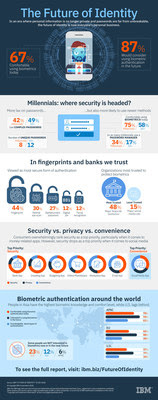
- Biometrics becoming mainstream: 67 percent are
comfortable using biometric authentication today, while 87 percent say
they'll be comfortable with these technologies in the future.
- Millennials moving beyond passwords: While 75 percent of millennials4
are comfortable using biometrics today, less than half are using
complex passwords, and 41 percent reuse passwords. Older generations
showed more care with password creation, but were less inclined to adopt
biometrics and multifactor authentication.
- APAC leading charge on biometrics: Respondents in APAC
were the most knowledgeable and comfortable with biometric
authentication, while the U.S. lagged furthest behind in these
categories.
The evolving threat and technology landscape has created widely-known
challenges with traditional log-in methods that rely heavily on
passwords and personal information to authenticate our identities
online. In 2017, data breaches exposed personal information, passwords,
and even social security numbers for millions of consumers.
Additionally, the average internet user in America is managing over 150
online accounts that require a password, which is expected to rise to
over 300 accounts in coming years.
5
"In the wake of countless data breaches of highly sensitive personal
data, there's no longer any doubt that the very information we've used
to prove our identities online in the past is now a shared secret in the
hands of hackers," said
Limor Kessem,
Executive Security Advisor, IBM Security. "As consumers are
acknowledging the inadequacy of passwords and placing increased priority
on security, the time is ripe to adopt more advanced methods that prove
identity on multiple levels and can be adapted based on behavior and
risk."
Security Takes Priority; Biometrics Seen as More Secure than PasswordsSurvey
results around security, convenience and privacy contradict the
long-held wisdom that "convenience is king." While consumers have long
been thought to prefer a fast sign-in experience with minimal friction,
the survey results show that people rank security as a higher preference
than privacy or convenience for the majority of applications –
particularly for money-related applications.
- Security was vastly ranked as the top priority for banking,
investing, and budgeting apps – for these categories on average, 70
percent selected security as the top priority, with 16 percent selecting
privacy, and 14 percent selecting convenience.
- Security also ranked as the top priority for online marketplaces, workplace apps, and email.
- For social media apps, priorities became less clear – with
convenience taking a slight lead (36 percent), followed by security (34
percent) and privacy (30 percent).
The survey also examined consumers' opinions around the security of
various login methods, and found that certain types of biometrics were
viewed as more secure than passwords, yet security and privacy remain
top concerns when it comes to adopting biometrics.
- 44 percent ranked fingerprint biometrics as one of the most secure
methods of authentication; passwords and PINs were seen as less secure
(27 percent and 12 percent respectively)
- People's biggest concerns with biometric authentication were
privacy (how the data is collected and used – 55 percent), and security
(others using fake biometric data to access their accounts – 50
percent).6
Age Gap: Older Generations Lead on Password Hygiene, Millennials Using Newer TechniquesThe
survey revealed several differences in generational viewpoints when it
comes to securing their online identities. Older adults displayed better
habits when it came to password creation, yet younger generations were
more inclined to adopt password managers, biometrics and multifactor
authentication as a way to secure their online accounts. This could be
an indication that younger generations have less confidence in passwords
and are instead looking to alternative methods to secure their
accounts.
- Only 42 percent of millennials use complex passwords that combine
special characters, numbers and letters (versus 49 percent of those 55
years of age and older), and 41 percent reuse the same password multiple
times (versus 31 percent of 55+).
- On average, people 55+ use 12 passwords, while Gen Z (ages 18 –
20) averages only five passwords, which could indicate a heavier re-use
rate.
- Millennials are 2x more likely to use a password manager (34 percent) than people over the age of 55 (17 percent).
- Millennials were more likely to enable two-factor
authentication in the wake of a breach (32 percent versus 28 percent
general population).
Young adults also showed the strongest preference for convenience,
with almost half (47 percent) of adults under 24 preferring a faster
sign-in experience to a more secure form of authentication. This may be
one reason that young people are more likely to adopt biometric
authentication, with 75 percent of millennials comfortable using
biometrics today compared to 58 percent of those over age 55.
Around the World: Location Impacts Password and Authentication PerspectivesThe
survey found that geographic location had a strong influence on
perception and familiarity with emergent authentication techniques, with
the
Asia Pacific
region being the most knowledgeable and comfortable with tactics like
multifactor authentication and biometrics. The U.S. lagged furthest
behind in awareness and comfort for most categories. Specifically:
- APAC respondents were the most likely to say they were knowledgeable
with biometrics (61 percent said they were knowledgeable vs. 40 percent
EU, 34 percent U.S.).
- APAC was also the most comfortable using biometrics today (78 percent comfortable vs. 65 percent EU, 57 percent U.S.).
- Europe
had the strongest password practices, with 52 percent of respondents
using complex passwords (vs. 46 percent in APAC and 41 percent in the
U.S.).
- 23 percent of respondents in the U.S. said they are not
interested in using biometrics now or in the near future - nearly double
the global average.
Future of IdentityAnalysis in the report by IBM Security
details that attitudes regarding authentication vary widely, and while
acceptance of newer forms of authentication like biometrics is growing,
concerns persist – particularly amongst older generations and people in
the U.S.
IBM advises organizations to adapt to these preferences by taking
advantage of identity platforms that provide users with choices between
multiple authentication options – for example, letting users toggle
between a mobile push-notification, which invokes fingerprint readers on
their phone, or a one-time passcode. Organizations can also balance
demands for security and convenience by using risk-based approaches that
trigger additional authentication checkpoints in certain scenarios,
such as when behavioral cues or connection attributions (device,
location, IP address) signal abnormal activity.
The data also reveals that younger generations are placing less
emphasis on traditional password hygiene, which poses a challenge for
employers and businesses that manage millennial users' access to data
via passwords. As the percentage of millennial and Gen Z employees
continues to grow in the workforce, organizations and businesses can
adapt to younger generations' proclivity for new technology by allowing
for increased use of mobile devices as the primary authentication factor
and integrating approaches that substitute biometric methods or tokens
in place of passwords.
IBM Security provides tips for consumers on how to secure their digital identities in a
blog post here.
For additional details on the study and advice for companies to
prepare for the future of authentication, download the full report at:
ibm.biz/FutureOfIdentity
About IBM SecurityIBM Security offers one of the most
advanced and integrated portfolios of enterprise security products and
services. The portfolio, supported by world-renowned IBM X-Force®
research, enables organizations to effectively manage risk and defend
against emerging threats. IBM operates one of the world's broadest
security research, development and delivery organizations, monitors 35
billion security events per day in more than 130 countries, and has been
granted more than 8,000 security patents worldwide. For more
information, please check
www.ibm.com/security, follow
@ibmsecurity on Twitter or visit the
IBM Security Intelligence blog.
About the StudyThe study was designed with Ketchum Global
Research and Analytics. Data collection was conducted by Research Now.
The survey was conducted
between October 21 and November 5, 2017, with a margin of error of +/- 2.0 for the U.S. sample and +/- 3.07 for the EU and APAC samples, at the 95% confidence level.
The 15-minute online survey totaled responses from 3,977 adults across
the United States (U.S.), European Union (EU) and
Asia-Pacific (APAC) regions, including:
- U.S.: 1,976 respondents
- EU: 1,004 respondents (United Kingdom, France, Italy, Germany, Spain)
- APAC: 997 respondents (Australia, India, Singapore)